
Quick answer: The highest radon numbers I see are right around the city of York, where the ground is limestone. Limestone is porous, so soil gas seeps through it. Tight shale can slow it down. And wherever there's water, it's always worse. But the rock is only half of it. Your next-door neighbor can test completely differently because of the backfill, the rubble and the foundation. That's why I look at your house and your ground before I give you a price.
I Learned This Ground One Basement at a Time
Before radon was all I did, I was a home inspector. I worked for an inspector first, then ran my own company, York Home Inspectors. Every inspection started the same way: down the basement stairs with a flashlight. Stone walls, block walls, wet corners, dirt floors under old additions. After a few years of that, you stop being surprised by what's under a York house.
Around 2017 I renamed the company Radon Mitigation York PA and went all in on radon. Same eyes, same flashlight, one job. My crew and I work out of North Hartley Street in York and go up to about 50 miles out. That's a lot of different ground, and it's why this page exists.
The Ground Matters as Much as the House
My foundation guide covers what's built on the ground: rubble, block, poured walls, crawl spaces. This page covers the ground itself. Radon comes from uranium breaking down in rock and soil. What that rock is, how cracked it is and how wet it is all change how much gas is waiting under your floor.
York County isn't one kind of ground. It's several, and they change fast. One side of a town can sit on completely different rock than the other side.
Three Kinds of Ground, Three Different Stories
| Where | What's underneath | What it means for radon |
|---|---|---|
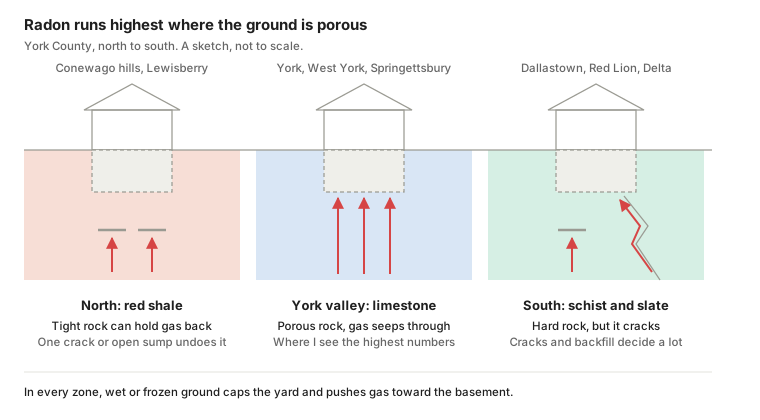
| York city, West York, North York, Springettsbury, Emigsville | Limestone and dolomite of the York valley | Where I see the highest numbers. Porous rock lets soil gas seep through. |
| South of the city: Dallastown, Red Lion, Shrewsbury, Glen Rock, down to the Delta slate belt | Schist, quartzite and slate of the Piedmont hills | Hard rock, but cracks, backfill and rubble decide a lot. Numbers swing house to house. |
| North toward the Conewago hills and Lewisberry | Red shale and mudstone of the Gettysburg basin | Tight shale can hold gas back. It still needs a test, because one crack or open sump undoes that. |
Limestone: Why the Numbers Run Highest Around York
The city and the towns around it sit on a valley of limestone and dolomite. Limestone dissolves over time. That leaves cracks, channels and open spots in the rock, and it leaves the soil on top richer in uranium, which is what radon comes from.
The U.S. Geological Survey lists this kind of limestone among the rock types most likely to cause indoor radon problems. It lines up with what I see: the highest numbers I run into are right around York.
From my jobs: York doesn't sit on one kind of rock. The rock bed changes, and one side of town can be vastly different from the other. I've learned not to assume anything from an address.
Shale to the North: The Ground That Can Hold It Back
North of the city, toward the Conewago hills and Lewisberry, you get into red shale and sandstone. Where that shale is solid and unbroken, it's tight and it can slow soil gas down or hold it back.
But it still has radon in it, and one crack in the rock, loose backfill or an open sump gives the gas a way around. So up there I say the same thing I say everywhere: test first.
The Hills to the South: Hard Rock, Lots of Variety
Head south out of the city, toward Dallastown, Red Lion, Shrewsbury and Delta, and you climb into hills of schist, quartzite and slate. Down around Delta that's the Peach Bottom slate that was quarried for more than a hundred years, and the borough still has slate roofs and slate sidewalks to prove it.
That rock doesn't dissolve like limestone, but it cracks, and it carries plenty of uranium of its own. Geologists have found the highest radon in Pennsylvania well water comes from these same Piedmont schists and quartzites. So the hills aren't a safe zone. What's around your foundation, the backfill, an old rubble wall, an addition, decides a lot of it.
Wherever There's Water, It's Always Worse
This is the one I'd put on a sign. Wet basement, high water table, a sump pump that never stops, a crawl space that smells damp. Every time there's water, the radon is worse.
Here's why. Soil gas normally leaks out of the ground through the yard. When the yard is soaked, the water plugs those openings like a lid. Geologists call it a capping effect. The gas still has to go somewhere, and the dry ground under your house is the easy way out. An open sump or a wall drain gives it a straight shot in.
Water is also why I do mold testing: the same wet basement that pushes radon up is usually growing something too.
If water is part of what's going on at your house, tell me at the walkthrough. It changes the plan.
Winter Makes It Worse Too
Frozen ground puts the same lid on the yard. Add a house that's shut tight for the winter with the heat running, and radon has more reason to come in and fewer ways to leave. The EPA says winter is when radon is most likely to build up in a house, and that's why winter is a good time to test. A winter number isn't wrong. It's an honest look at your worst season.
Why Your Next-Door Neighbor Tested Differently
I hear this all the time: "The neighbor tested low, so we're probably fine." Not necessarily. Next-door houses test differently for four reasons.
- Backfill. The dirt and stone pushed back around a foundation after it was built. Loose, rocky backfill lets gas move. Tight clay slows it down.
- Rubble. An old rubble foundation has gaps all through it. The house next door might have poured walls.
- The foundation. Block, poured, stone, slab and crawl space all let gas in differently.
- The rock. Around York it can change within a few blocks.
From my jobs: I've seen houses right next door to each other test very differently. Same street, same age, different backfill and foundation. The only number that counts is the one from your house.
Jobs I See All the Time
The city rowhome. An old rowhome near downtown, stone cellar, patched floor, maybe a dirt corner under the stairs. These are the hardest and the most common. They usually need more than one suction point and a lot of sealing.
The house that's under contract. The buyer's inspector runs a 48-hour test, it comes back over 4, and now there's a closing date. I spent years as an inspector, so I know how those deadlines work. I get out there fast, quote it in writing, and plan the install and the retest around the closing.
The newer house with a pipe and no fan. A newer house in a subdivision with a capped PVC pipe coming out of the basement floor. The builder put in a passive system and never finished it. Adding a fan is often the easiest job I do, as long as the pipe is in a spot that works.
The wet basement. A basement with a sump that's always running. The open sump is a straight path for soil gas. A sealed lid you can still get the pump out of often turns the sump into the suction point.
Why I Won't Shoot From the Hip or Quote Over the Phone
Pennsylvania has one of the most serious radon problems in the country. About 40% of homes tested in the state come in over the EPA's action level of 4 pCi/L. York County is in the EPA's Zone 1, the highest-risk category, and York County homeowners have sent PA DEP nearly 99,000 radon test results over the years. Those numbers prove the problem is real here. They can't tell you what your house needs.
That's why I don't shoot from the hip. I don't quote by ZIP code or over the phone. I come out, look at the foundation, look at the floor, look at the sump and the ground around the house, and run a pressure field test. Then you get one price, in writing, before anything's scheduled. My foundation guide walks through exactly what I check.
Radon in Well Water
Out in the rural parts of the county, a lot of homes are on wells, and radon can come into the house through the water. When you shower, run the dishwasher or do laundry, the radon in the water escapes into the air. Pennsylvania DEP's rule of thumb: every 10,000 pCi/L in the water adds about 1 pCi/L to the air.
The rock matters here too. The highest radon in Pennsylvania well water comes from the schist and quartzite in the southern hills, the same ground south of York toward Red Lion and Delta. There's no state limit for radon in a private well, so nobody checks it unless you do. If it's high, there are two common fixes: an aeration system or a carbon filter.
I can test your well water for radon when I test the air. For anything else in your water, like bacteria or nitrates, you'll want a certified water lab.
Questions I Get About York County Radon
Where is radon highest in York County?
In my experience, right around the city of York. The limestone under the York valley is porous and lets soil gas seep through.
Does living on shale mean I don't need a test?
No. Solid shale can slow gas down, but it still carries radon, and a crack, loose backfill or an open sump can let it in. Every house needs its own test.
My neighbor tested low. Am I low too?
Not necessarily. Backfill, rubble, foundation type and the rock under each lot differ. Next-door houses can test very differently.
Does a wet basement make radon worse?
Yes. Wherever there's water, it's always worse. Soaked ground pushes soil gas toward the easiest way out, which is often your basement.
Can you give me a price over the phone?
No. I need to see the foundation and the ground first. You get a written price after the walkthrough, and it doesn't change on install day.
Can you test my well water for radon?
Yes. I can test your well for radon when I test the air. Radon in water gets into the air when you shower and run water, and the highest well-water radon in Pennsylvania comes from the rock in the southern hills. For other water tests, like bacteria or nitrates, use a certified water lab.
Where I Work
My crew and I test and install systems across York County and up to about 50 miles out, including York Township, Spring Garden Township, Manchester Township, Dallastown, North York and West York. Don't know your number yet? Start with a radon test. Already have it? Schedule a walkthrough or call (717) 400-8392.
More guides: all radon guides